We are working on the site and some pages might be unavailable.

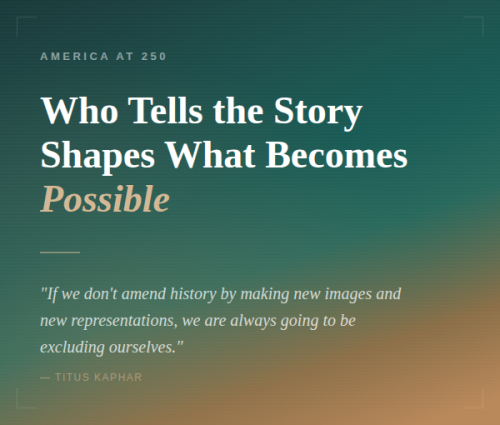
America at 250: Who Tells the Story Shapes What Becomes Possible

 
America250 Banner

As the nation approaches its 250th anniversary, we are witnessing more than preparations for a national milestone. We’re witnessing a struggle over who gets to define America, whose stories count, and what futures become possible.

The White House’s Freedom 250 initiative is advancing a familiar narrative of uncomplicated triumph: traveling “Freedom Trucks,” monument restorations, and a telling of the founding that treats slavery as a footnote, Indigenous dispossession as a settled chapter, and the contributions of Latino, Asian American, and immigrant communities as peripheral to the American story. Narrative is part of the infrastructure of democracy. The stories a society elevates shape what gets funded, what gets protected, what gets erased, and whose humanity, leadership, and experiences are recognized in public life.

These battles over history and narrative are not abstract cultural debates. They shape the conditions under which people are trying to govern, organize, advocate, teach, heal, and build community. When public narratives narrow and truth becomes contested terrain, the ripple effects extend beyond museums and commemorations into policy decisions, institutional priorities, and the possibilities communities envision for themselves.

At CURE, we work alongside nonprofit organizations, coalitions, public agencies, and community leaders navigating exactly these realities, where the tools for advancing racial equity are increasingly contested even as the need for them intensifies locally. We see leaders defending hard-won gains while grappling with burnout, backlash, and political uncertainty, yet still working to build trust, strengthen democratic participation, and move communities toward equity, justice, and belonging. In a moment when narratives shape the boundaries of what’s possible, truth-telling, critical reflection, and reparative practices that strengthen dialogue, trust, and belonging are not peripheral to the work. They are part of how communities imagine, defend, and build the futures they deserve.

For a fuller story on America at 250, explore the articles and resources below. 

What We’re Reading, Watching and Exploring

Art  As Counter-Narrative

  • Bisa Butler – Quilted portraits that transform historical photographs of Black life into vivid, larger-than-life celebrations of dignity and cultural memory.
  • Titus Kaphar – Artwork that disrupts classical portraiture and historical imagery to reveal the people and histories American narratives often leave out.
  • Corky Lee – Fifty years of “photographic justice” including recreating the 1869 transcontinental railroad photo that erased Chinese laborers who built it.
  • Favianna Rodriguez – Printmaking that centers migration, belonging, and the humanity of immigrant communities.
  • Jaune Quick-to-See Smith – Map paintings that layer Indigenous presence over U.S. borders, making visible the people and land that official narratives erase.

Judy Lubin

Dr. Judy is an applied sociologist, racial equity changemaker, yoga and mindfulness practitioner, author, auntie, bestie and beach lover. Judy’s elemental nature is water, and with her she brings calming, reflective energy to hold space for deep listening, inner work and transformative dialogue. 

The curator of the Embodied Justice program, she hosts the accompanying podcast and co-facilitates events and dialogues focused on the collective healing and sustainability of Black changemakers.

At CURE, Dr. Judy has built transformative racial equity frameworks and change management processes that have impacted thousands of lives. She began her career focused on health disparities, recognizing that stress from societal racism can become embodied and manifested through “weathering” that prematurely ages the body and shortens the lifespan of racially marginalized communities. 

She is unapologetically committed to centering Black people and the communities that have inspired her life’s work. The daughter of Haitian immigrants, she grew up in South Florida surrounded by music, her grandmother’s herbal garden, and the struggle to make it in a country that saw her family as outsiders. 

In 2022, after experiencing multiple health emergencies coupled with burnout from the intensity of the “racial reckoning” that increased demand for CURE’s racial equity services, Judy began a process of listening to the wisdom of her body, healing old trauma wounds, and reclaiming rest and her love of mind-body healing. During this time she explored somatics, indigenous and and ancestral healing practices and earned certifications in multiple healing modalities including yoga and energy medicine.

Emerging from a place of rest and listening to what her soul wanted to share, she now weaves mindfulness, body-awareness and spiritual activism to support changemakers and organizations to regenerate their leadership and give to the world from a place of ease and wholeness. 

Long committed to promoting women’s health and wellness, she is the author of The Heart of Living Well: Six Principles for a Life of Health, Beauty and Balance.

Find Judy on instagram or linkedin at @drjudylubin, where she (occasionally) shares posts celebrating Black joy, healing and well-being.

Shawn J. Moore

Residing at the intersection of leadership and mindfulness, Shawn creates sacred spaces for stillness and self-inquiry to help social impact leaders align their strengths, intention, and impact. Through his integrative approach, he holds transformative containers for self-renewal, personal discovery, and capacity-building that ease clients on their journey towards peace, clarity, and freedom.

Shawn is committed to empower changemakers to become embodied leaders – unified in mind, body, and heart – with the tools to mindfully pause, reconnect to their inner knowing, make strengths-driven decisions, and lead the change they believe the world needs.  

Reckoning with his own contemplation of burnout, purpose, and alignment, Shawn transitioned out of his role as Associate Dean of Student Life & Leadership at Morehouse College in the fall of 2021 to focus more on mindfulness and stillness-based training programs and workshops. 

While leadership resonates with him deeply, it is his personal and spiritual practices that allows him to continue to show up for himself and others. He is a yoga teacher (E-RYT® 200, RYT® 500, YACEP®), sound and reiki practitioner, meditation teacher, Yoga Nidra facilitator, and Gallup-Certified Strengths Coach, all focused through a Buddhist lens and 17 years of personal practice. He has contributed workshops, practices, and educational opportunities for celebrities like Questlove and Dyllón Burnside, and various yoga studios and colleges, Yoga International, Omstars, Melanin Moves Project, the Human Rights Campaign, Spotify and Lululemon. He currently serves as the Facilitation and Community Manager for BEAM (Black Emotional & Mental Health Collective).

Shawn hosts a podcast called The Mindful Rebel® Podcast that creates a platform to continually explore this unique intersection of leadership and mindfulness. Find him on instagram @shawnj_moore 

This Website Collects Cookies.

We use cookies to analyze website traffic and to provide a better browsing experience.