Author name: webdev

Podcast

Sacred Activism: Embracing Collective Healing with Michelle C. Johnson

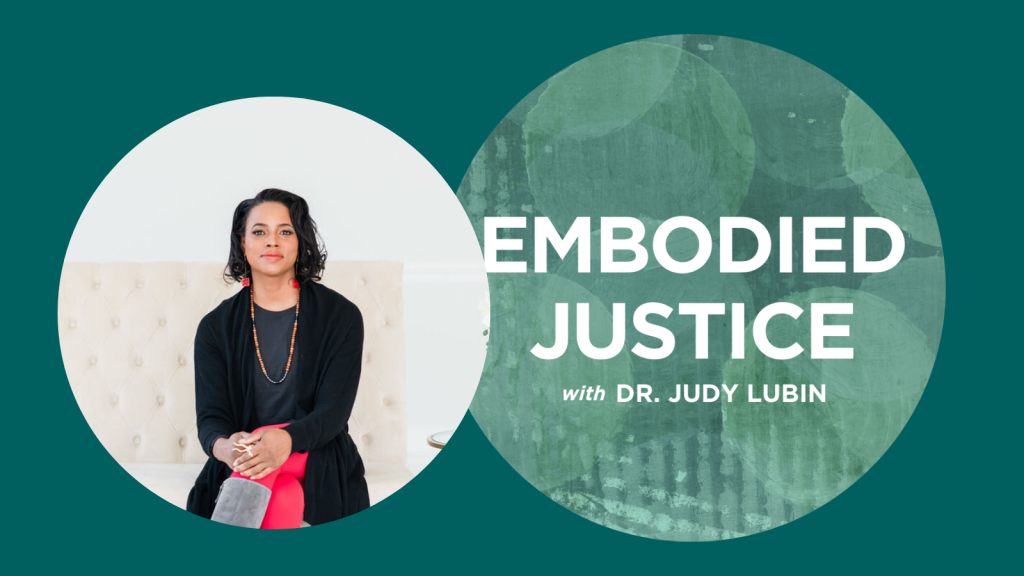
In the inaugural episode of “Embodied Justice,” host Dr. Judy Lubin sits down with Michelle C. Johnson, a multifaceted champion for racial equity, social justice, and healing. They delve into the transformative nexus of sacred activism, ancestral healing, and personal practices. This soul-stirring dialogue invites us into a realm where we recognize our interconnectedness and engage in the collective work of building a world infused with justice, and care. The Sacredness of Activism Rekindling Our Collective Responsibility Michelle C. Johnson introduces us to the notion of sacred activism, a powerful blend of spiritual consciousness and social action. Sacred activism transcends traditional activism by rooting collective change in a framework of mutual care and integrity. It recognizes the importance of individual roles in nurturing collective healing. Johnson doesn’t shy away from the formidable: she asks us to engage with the profound, emphasizing the need for practices that call us into healing work and knit us closer together. Sacred activism, she suggests, is our calling to mend the world’s deep-seated wounds with reverence and intention. The Significance of Ancestral Wisdom Honoring Our Lineage for Healing The conversation shifts towards the importance of calling in our ancestors for guidance in today’s quest for justice. Johnson speaks candidly about how ancestral wisdom illuminates our paths and provides strength for the arduous journey. The legacies of our forebears, according to Johnson, come with a mandate to alleviate the suffering on our planet. She underscores the transformative shift in global consciousness triggered by tragedies such as the murder of Trayvon Martin, which reverberates through our collective heart and demands an unwavering commitment to healing past and present traumas. Contemplative Practices in Unsettling Times Fostering Connection and Resilience In an age where relentless urgency often marginalizes rest, Johnson brings up various contemplative practices that serve as lifelines to ourselves and our communities. Meditation, journaling, lighting candles, or simpler acts like gardening signify not just moments of pause but lifelines to something grander. Such practices anchor us amid chaos, allowing for an enriched connection with our ancestral roots and the spirit that pervades us all. Dr. Lubin reflects on this accessibility and highlights that even in the midst of constant assault, these practices offer a healing power that can’t be overstated. To stay within the healing process, Johnson and Dr. Lubin discuss the critical role of dreaming. Visioning a future where another world is possible serves as a counterforce to the pain wrought by systemic oppression and racial trauma. Johnson posits that dwelling in spaces of dreaming and joy is as significant as naming our collective grief and trauma. An Embodied Justice lens is about understanding how we sustain our fight for justice while anchoring ourselves in spaces where joy and sorrow coexist. Creating Spaces for Transformation Navigating Change with Care and Intention As we confront the realities of systemic neglect and trauma, Michelle C. Johnson reminds us that holding space for transformation comes with challenges. The fierce work of change-makers needs nurturing, prompting Johnson to stress the significance of finding solace in nature, community, and personal practices. She discusses the Embodied Justice Program aimed at supporting black change-makers, which embodies this ethos of community care. Creating these spaces enables us to face chaos with resilience, promoting a healing that is generative and transformative. Michelle C. Johnson’s perspective on embodied justice challenges us to weave sacred activism into the fabric of our lives. By acknowledging our shared histories of grief and aspiration for healing, we equip ourselves to craft a reality where justice can truly flourish. Dr. Judy Lubin’s conversation with Johnson compels us to consider how we individually contribute to the collective alleviation of suffering. As we engage with Michelle C. Johnson’s profound insights, let us commit to a practice of sacred activism that celebrates our shared humanity and the dream of a more just and compassionate world. Learn More about Our Guest Michelle’s work focuses on the intersections of justice, spirituality, and healing, aiming to create spaces for individual and collective transformation. She has led dismantling racism work in many settings and two decades of practice as a clinical social worker. Michelle is the author of impactful books such as “Skill in Action: Radicalizing Your Yoga Practice to Create a Just World”, We Heal Together: Rituals and Practices for Building Community and Connection, and “Finding Refuge: Heart Work for Healing Collective Grief.”And she also hosts the “Finding Refuge” podcast, where she engages with a wide array of guests to explore themes of social justice, spiritual healing, and collective liberation. Connect With Michelle On her website: https://www.michellecjohnson.com On instagram: https://www.instagram.com/skillinaction On her podcast: https://www.michellecjohnson.com/finding-refuge-podcast
Uncategorized

New Logo & Embodied Justice Program

It’s been a while since you heard from us and we’re excited to share what’s been cooking at CURE. There’s no doubt that we’re living in unpredictable times: grieving humanitarian crises and facing daily pressures that threaten our ability to connect with ourselves and each other. Collective trauma has become a steady state that requires us to consistently, intentionally (and even defiantly) embody a future where we are all free and well. Creating new systems, narratives and ways of being is healing work, yet our well-being often suffers in service to the cause. Last summer, our organization took a pause to rest and reset. As a small team tackling big issues, we’ve been thinking a lot about the sustainability and healing of Black changemakers, who are often simultaneously navigating anti-Blackness and white supremacy as they lead efforts to dismantle oppressive cultures, structures and policies in organizations and communities. Emerging from our time of rest and reflection, it was clear that we needed to realign our work to more clearly articulate our reason for being: restoring wholeness to marginalized communities by cultivating pathways for racial equity, justice, collective healing, well-being and liberation. Over the next few months we’ll be rolling out a few new offerings. For now we’re excited to debut our new logo and website, plus a preview of our new program: Embodied Justice. We’ve chosen to ground our vision and offerings in the promise of a “CURE”. For us, this means reparative practices and policies that enable people and communities to experience healing and wholeness. We’re also thrilled to share that CURE is now fiscally sponsored by Possibility Labs. Through an aligned partnership with Possibility Labs, we now have the infrastructure to welcome donations to aid our new program offerings and infrastructure development. For ways to support CURE and our wish list, click here. We remain certain that we can build a better world, and we’re grateful to make that journey with you. In partnership, Dr. Judy Lubin, President and the CURE Team CURE’s new logo reflects the change we hope to facilitate through our renewed focus on “racial equity work that builds, empowers and restores.” The logo features the Tabono: an ancient West African (Adinkra) symbol that represents resilience, shared purpose and the willpower to realize our collective dreams. Our stylized version of the Tabono is surrounded by abstract representations of people gathered in reciprocal relationships and toward a singular purpose: liberation through equity, justice, healing and self-determination. And what’s a new vision without a new look? CURE’s updated website is marked by imagery that aligns with our values of collaboration, collective well-being and liberation through social and personal transformation. The dominant colors, brown and sage, were chosen to signify community, strength, and well-being. The site is an expression of who we are and we hope it helps you connect with us!

Uncategorized

Equity and Advocacy Collective Impact Report

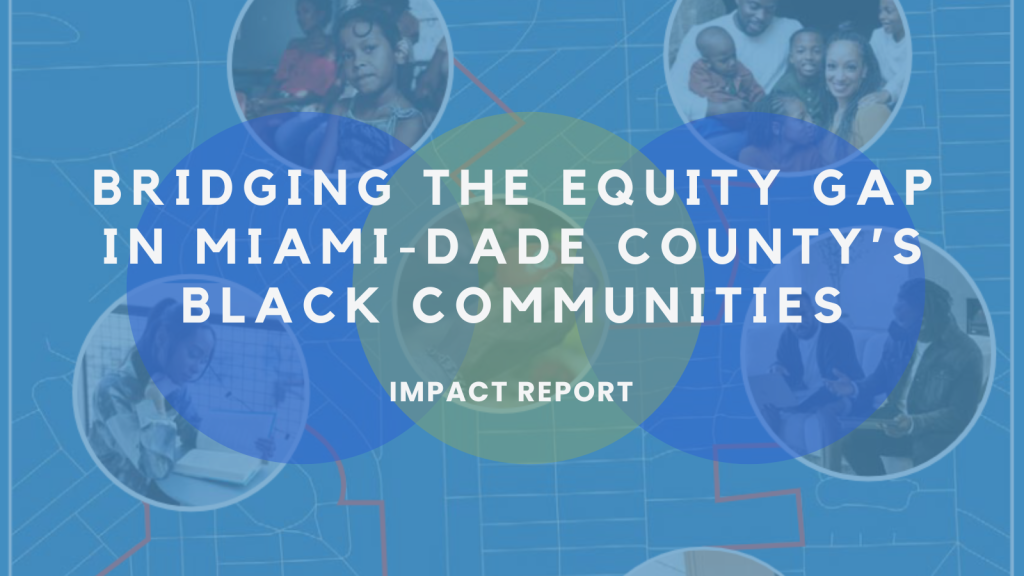
In partnership with Florida Memorial University Institute for Social Justice, CURE led research and writing for the Equity and Advocacy Collective’s (EAC) impact report (released January 2024). The EAC is a collective of 11 Black-led Miami-Dade organizations, touching 1 out 2 Black households in the county. With most of the EAC members serving the historically Black neighborhoods of Miami-Dade for 20 years or more, the report showcases powerful stories of the EAC’s impact and legacy. Read the report here.

Uncategorized

Newsletter: Affirmative Action, Celebrating Pride and the Freedom to Learn

The Imminent Threat of Ending Affirmative Action The impending Supreme Court ruling on Students for Fair Admissions (SFFA) v. Harvard and SFFA v. University of North Carolina will determine the future of affirmative action on college campuses. The two cases were organized  by Edward Blum, a conservative activist on a decades-long crusade to erase the consideration of race and ethnicity in higher education. If successful, the Supreme Court will overrule its prior decisions on affirmative action, going against a nearly 50 year precedent. A decision to eliminate affirmative action by the conservative leaning Supreme Court will adversely impact diversity in higher education, hinder economic mobility and have chilling effects on racial equity, diversity and inclusion efforts in corporations and sectors such as health care that continue to experience inadequate representation of Black and Brown professionals. Black and Latino students are more underrepresented at the nation’s top universities today than 35 years ago. Eliminating or limiting affirmative action places pressure on administrators in higher education to find alternative ways to ensure diversity in colleges that they fear will be ineffective in addressing current disparities. While Supreme Court rulings over the years have limited its application in college admissions as a measure solely to ensure diverse learning environments (and not to address past racial discrimination), affirmative action has been effective in increasing access to higher education for historically marginalized groups and has reduced racial biases and prejudices among white students who benefit from a diverse student body. The affirmative action cases in the Supreme Court align with several dangerous new precedents that erode civil rights including the recent reversal of Roe v. Wade and the growing anti-truth movement that includes book bans, dismantling of DEI offices at colleges and universities, and policies that limit classroom discussions about systemic racism, white supremacy, intersectionality, and racial and gender equity. Decision Day Events (June 22) Following the Court’s decision, a coalition of civil rights groups will convene on a virtual conference. The conference will be streamed live on the National Urban League’s Facebook page. Additionally, the African American Policy Forum (AAPF) will host a virtual Roundtable of leading lawyers, scholars, activists, and thought leaders to offer a critical assessment in real time of the legal, political, and cultural landscape for racial remedies in the wake of the decision. To reserve a spot, register here. Celebrating Pride Month Black and Brown LGBTQ rights activists have expanded our understanding of freedom and taught us how to live authentic lives. Every Monday this month we’re highlighting activists, from leaders in the Stonewall Riots to beloved storytellers and public figures. Follow us on LinkedIn, Instagram, Facebook and Twitter to check out our posts. Organizing Spotlight A national call to action, the Freedom to Learn campaign, has been ignited by the African American Policy Forum to collectively raise our voices against the anti-truth/anti-woke movement that threatens our democracy and antiracist efforts in schools, campuses and workplaces. With major actions including rallies in NYC and DC in May, new opportunities this month to join ongoing mobilizations include: In honor of Juneteenth, the Transformative Justice Coalition and others offer a week-long Juneteenth “Stay Woke Rolling Protest” in Florida. Register here. A Freedom to Learn Homeroom session will take place June 29th at 7:30pm ET. Register here. People for the American Way will host the Grandparents For Truth Event on June 30 in Philadelphia at the corner of Market Street & N. The event is a rallying call to defend the freedom to learn and fight back against authoritarianism and censorship. Join partners at 9am ET for the activities. From July 30 – August 3 AAPF offers Critical Race Theory (CRT) Summer School 2023 Presents: Defending the Freedom to Learn. Follow the Freedom to Learn Network here. Reading Lists: What We’re Reading? Los Angeles Times | Opinion: Affirmative action isn’t hurting Asian Americans. Here’s why that myth survives WNYC Studios | What if the Supreme Court Ends Affirmative Action? VOA News | How North Carolina Students View the Lawsuit Threatening Affirmative Action Forbes | Ending Affirmative Action Would Be A Terrible Mistake The New York Times | Affirmative Action Was Banned at Two Top Universities. They Say They Need It The New York Times| Diversity vs. Fairness In Case You Missed It: Deepening Our Understanding of the Power of Rest We joined the Congressional Black Caucus Foundation (CBCF) on IG Live for a discussion on the power of rest. Following the release of CBCF’s report entitled The Power of Rest: Examining the Racial Disparities of Sleep & its Connections to Black Health Outcomes, the discussion explored the critical role sleep plays in our everyday lives and the need to highlight its impact on racial equity. “For Black people, a third of health related deaths are from illnesses related to and directly impacted by poor sleep. Diabetes, stroke, heart disease, cancer comprise a large proportion of health-related deaths in Black communities and we are not addressing one of the key factors to these health conditions which is rest and sleep.” The IG Live features CURE’s Dr. Judy Lubin, a CBCF National Racial Equity Initiative (NREI) Ambassador, and the publication’s author, Solomon Ayalew. Watch the recording here.

Scroll to Top

Judy Lubin

Dr. Judy is an applied sociologist, racial equity changemaker, yoga and mindfulness practitioner, author, auntie, bestie and beach lover. Judy’s elemental nature is water, and with her she brings calming, reflective energy to hold space for deep listening, inner work and transformative dialogue. 

The curator of the Embodied Justice program, she hosts the accompanying podcast and co-facilitates events and dialogues focused on the collective healing and sustainability of Black changemakers.

At CURE, Dr. Judy has built transformative racial equity frameworks and change management processes that have impacted thousands of lives. She began her career focused on health disparities, recognizing that stress from societal racism can become embodied and manifested through “weathering” that prematurely ages the body and shortens the lifespan of racially marginalized communities. 

She is unapologetically committed to centering Black people and the communities that have inspired her life’s work. The daughter of Haitian immigrants, she grew up in South Florida surrounded by music, her grandmother’s herbal garden, and the struggle to make it in a country that saw her family as outsiders. 

In 2022, after experiencing multiple health emergencies coupled with burnout from the intensity of the “racial reckoning” that increased demand for CURE’s racial equity services, Judy began a process of listening to the wisdom of her body, healing old trauma wounds, and reclaiming rest and her love of mind-body healing. During this time she explored somatics, indigenous and and ancestral healing practices and earned certifications in multiple healing modalities including yoga and energy medicine.

Emerging from a place of rest and listening to what her soul wanted to share, she now weaves mindfulness, body-awareness and spiritual activism to support changemakers and organizations to regenerate their leadership and give to the world from a place of ease and wholeness. 

Long committed to promoting women’s health and wellness, she is the author of The Heart of Living Well: Six Principles for a Life of Health, Beauty and Balance.

Find Judy on instagram or linkedin at @drjudylubin, where she (occasionally) shares posts celebrating Black joy, healing and well-being.

Shawn J. Moore

Residing at the intersection of leadership and mindfulness, Shawn creates sacred spaces for stillness and self-inquiry to help social impact leaders align their strengths, intention, and impact. Through his integrative approach, he holds transformative containers for self-renewal, personal discovery, and capacity-building that ease clients on their journey towards peace, clarity, and freedom.

Shawn is committed to empower changemakers to become embodied leaders – unified in mind, body, and heart – with the tools to mindfully pause, reconnect to their inner knowing, make strengths-driven decisions, and lead the change they believe the world needs.  

Reckoning with his own contemplation of burnout, purpose, and alignment, Shawn transitioned out of his role as Associate Dean of Student Life & Leadership at Morehouse College in the fall of 2021 to focus more on mindfulness and stillness-based training programs and workshops. 

While leadership resonates with him deeply, it is his personal and spiritual practices that allows him to continue to show up for himself and others. He is a yoga teacher (E-RYT® 200, RYT® 500, YACEP®), sound and reiki practitioner, meditation teacher, Yoga Nidra facilitator, and Gallup-Certified Strengths Coach, all focused through a Buddhist lens and 17 years of personal practice. He has contributed workshops, practices, and educational opportunities for celebrities like Questlove and Dyllón Burnside, and various yoga studios and colleges, Yoga International, Omstars, Melanin Moves Project, the Human Rights Campaign, Spotify and Lululemon. He currently serves as the Facilitation and Community Manager for BEAM (Black Emotional & Mental Health Collective).

Shawn hosts a podcast called The Mindful Rebel® Podcast that creates a platform to continually explore this unique intersection of leadership and mindfulness. Find him on instagram @shawnj_moore 

This Website Collects Cookies.

We use cookies to analyze website traffic and to provide a better browsing experience.